Summary
America’s most recognizable landmarks—such as the Statue of Liberty, the Grand Canyon, and the Golden Gate Bridge—did not become icons overnight. Through history, engineering achievement, cultural symbolism, tourism, media exposure, and national storytelling, these sites evolved into powerful symbols of American identity. Understanding how they gained iconic status reveals how geography, history, and culture shape the American imagination.
Why Certain Landmarks Become Cultural Symbols
Every country has notable places, but only a few evolve into symbols that represent the entire nation. In the United States, landmarks often become cultural icons when they combine historical meaning, visual uniqueness, public accessibility, and strong storytelling.
A landmark becomes iconic when millions of people recognize it instantly—even if they have never visited it. Think of the Statue of Liberty greeting immigrants in New York Harbor or the towering granite faces at Mount Rushmore. These places carry emotional, historical, and political meaning that extends far beyond their physical structures.
Several forces typically drive the transformation of a landmark into a cultural symbol:
- Historical events connected to the location
- Distinctive architecture or natural beauty
- Media exposure in films, photography, and news
- Tourism and public accessibility
- Government preservation and promotion
- Educational narratives taught in schools
When these factors overlap for decades—or even centuries—a place can move from a regional attraction to a national emblem.
The Statue of Liberty: Immigration, Freedom, and Global Recognition
Few landmarks illustrate cultural symbolism more clearly than the Statue of Liberty.
Gifted to the United States by France in 1886, the statue quickly became associated with the idea of liberty. Yet its true cultural impact grew in the late 19th and early 20th centuries as millions of immigrants arrived in New York Harbor.
For many newcomers, the statue represented their first glimpse of America.
Emma Lazarus’s famous poem “The New Colossus,” added to the pedestal in 1903, reinforced this symbolism. The line “Give me your tired, your poor, your huddled masses yearning to breathe free” connected the monument to the immigrant experience.
Over time, the statue became far more than a sculpture. It became:
- A global symbol of democracy
- A welcoming image for immigrants
- A centerpiece of American political rhetoric
- One of the most photographed landmarks in the world
According to the National Park Service, the Statue of Liberty receives millions of visitors annually, reinforcing its role as a cultural destination rather than simply a historic monument.
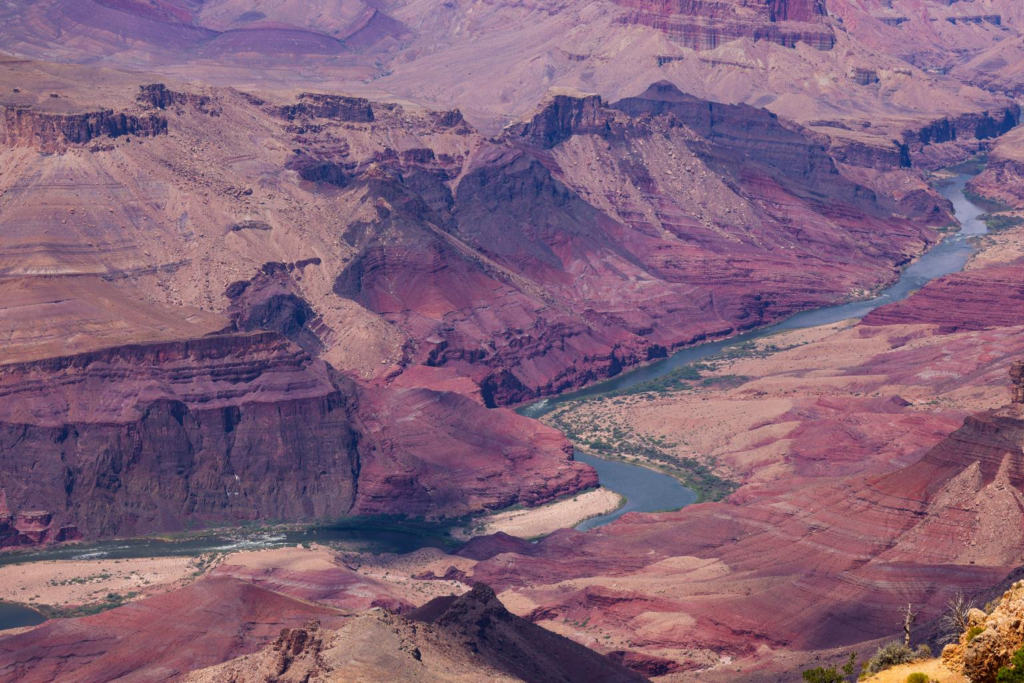
The Grand Canyon: Natural Wonder Turned National Identity
Unlike man-made monuments, some American icons are natural landscapes.
The Grand Canyon in Arizona became famous not only because of its immense scale but also because early explorers, photographers, and conservationists helped shape its narrative.
In the late 1800s, photographer William Henry Jackson and explorer John Wesley Powell documented the canyon, introducing it to a national audience. Their work helped persuade political leaders that the canyon should be preserved.
President Theodore Roosevelt famously declared during a 1903 visit:
“Leave it as it is. You cannot improve on it.”
The creation of Grand Canyon National Park in 1919 transformed the site into one of America’s most celebrated natural landmarks.
Several factors strengthened its iconic status:
- Dramatic geology visible from miles away
- Early promotion by railroad tourism campaigns
- Appearances in documentaries and films
- Inclusion in school textbooks and travel literature
Today, the canyon attracts nearly 5 million visitors each year, according to National Park Service data.
Mount Rushmore: Sculpting National Memory Into Stone
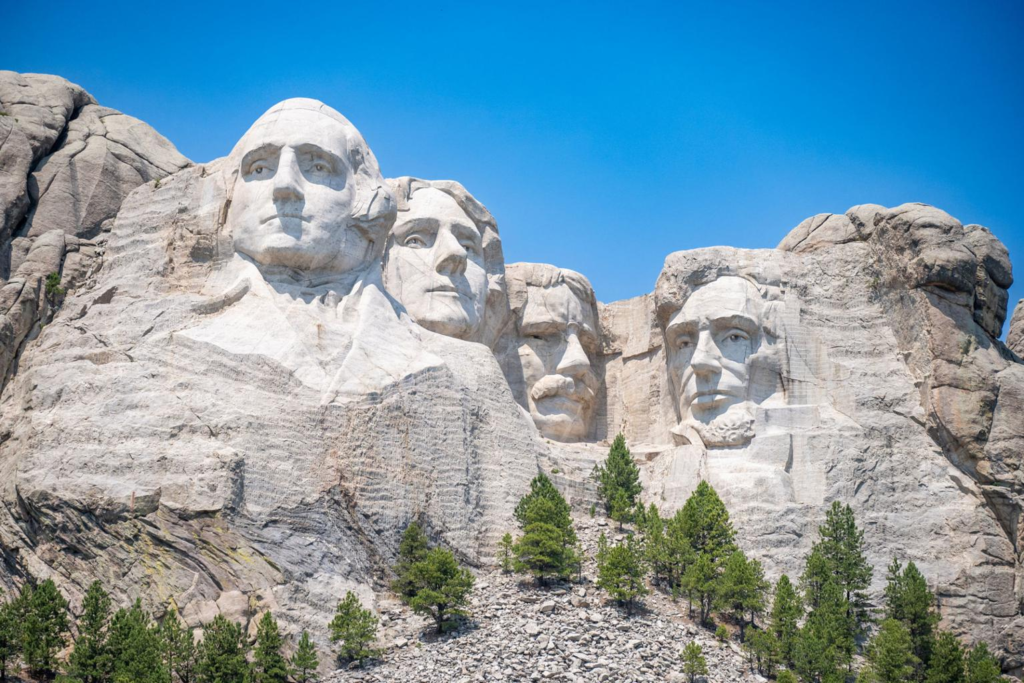
Mount Rushmore is one of the most deliberate attempts to create a national icon.
Located in South Dakota’s Black Hills, the monument features 60-foot sculptures of four presidents:
- George Washington
- Thomas Jefferson
- Theodore Roosevelt
- Abraham Lincoln
Sculptor Gutzon Borglum began carving the monument in 1927. The project was partly designed to attract tourism to the region, but it quickly developed deeper meaning.
Each president represents a different stage in American history:
- Washington – the nation’s founding
- Jefferson – expansion and democracy
- Lincoln – preservation of the Union
- Roosevelt – industrial growth and global influence
By embedding these figures into a mountain, the monument transformed political history into a visual national narrative.
Even today, Mount Rushmore remains a powerful image used in textbooks, documentaries, and political symbolism.
The Golden Gate Bridge: Engineering as Cultural Identity
Not all cultural icons are centuries old. Some achieve symbolic status through technological achievement.
Completed in 1937, the Golden Gate Bridge connected San Francisco to Marin County and quickly became one of the most recognizable bridges in the world.
At the time of its completion, it was the longest suspension bridge span in the world, a remarkable engineering accomplishment during the Great Depression.
Several features helped the bridge become iconic:
- Its dramatic Art Deco design
- The distinctive “International Orange” color
- Its setting against San Francisco Bay
- Frequent appearance in films and television
The bridge also became a symbol of West Coast innovation and ambition. Its silhouette is now synonymous with the city itself.
Today, the Golden Gate Bridge carries over 100,000 vehicles daily while continuing to serve as a global architectural icon.
How Media Turned Landmarks Into Household Names
Mass media has played a major role in elevating American landmarks to cultural prominence.
Throughout the 20th century, photography, film, and television brought distant locations into people’s homes. When viewers repeatedly see the same locations in movies or news broadcasts, those places become embedded in collective memory.
Hollywood has particularly amplified the cultural reach of certain landmarks.
Examples include:
- The Golden Gate Bridge appearing in disaster and action films
- The Lincoln Memorial featured in civil rights documentaries
- The Empire State Building in classic New York cinema
- The Grand Canyon in Western films
The more often these places appear in media, the more they become visual shorthand for American culture.
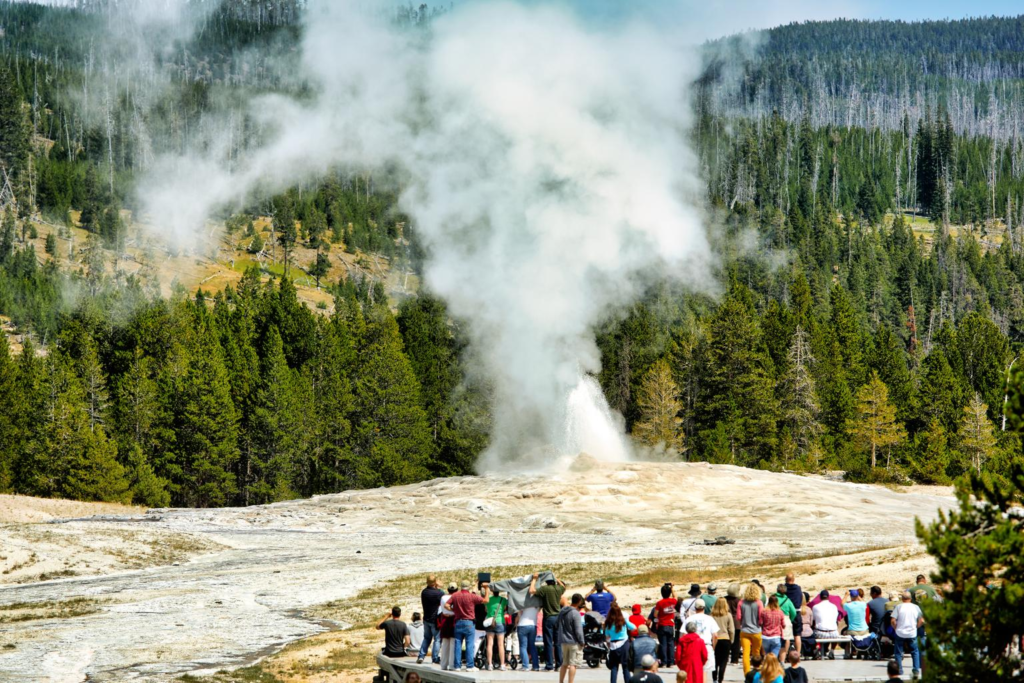
Tourism and National Parks Helped Cement Icon Status
Tourism has played a powerful role in reinforcing landmark recognition.
Beginning in the early 1900s, railroads promoted travel to scenic locations across the United States. Tourism campaigns encouraged Americans to explore their own country, particularly national parks.
The creation of the National Park Service in 1916 helped formalize preservation and public access to many iconic landscapes.
National parks and monuments now serve several functions:
- Protect historic or natural resources
- Educate visitors about American history
- Support regional economies through tourism
- Strengthen national identity
Today the National Park System receives over 300 million recreational visits annually, according to federal data.
Education and National Storytelling
Another factor behind iconic landmarks is education.
Many Americans first learn about major landmarks in elementary school textbooks. Field trips, documentaries, and historical lessons reinforce the idea that certain locations represent important moments in national history.
For example:
- The Lincoln Memorial is linked with the Civil Rights Movement.
- Independence Hall represents the birth of American democracy.
- The Alamo symbolizes resistance and Texas identity.
Over time, these stories become part of the country’s shared cultural narrative.
Why Iconic Landmarks Matter to American Culture
Landmarks do more than attract tourists. They shape how Americans understand their history and values.
Iconic places function as physical reminders of national identity. They anchor abstract ideas—freedom, exploration, democracy—in real, visible locations.
They also serve as gathering spaces during historic moments.
For instance:
- The Lincoln Memorial hosted Martin Luther King Jr.’s “I Have a Dream” speech.
- Times Square has become a global symbol of New Year celebrations.
- The National Mall frequently hosts major demonstrations and civic events.
Because of these associations, landmarks become living parts of the national story rather than static monuments.
Frequently Asked Questions
Why do certain landmarks become more famous than others?
Landmarks often become famous when they combine historical significance, distinctive design or scenery, strong media exposure, and accessibility to the public.
What is the most visited landmark in the United States?
Times Square in New York City is widely considered the most visited tourist attraction in the U.S., with tens of millions of visitors annually.
How do landmarks influence national identity?
They provide physical representations of national values such as freedom, democracy, innovation, and exploration.
Who decides which landmarks are preserved?
Many are protected by the National Park Service, while others are preserved by state governments, historical societies, or nonprofit organizations.
Why is the Statue of Liberty such an important symbol?
It represents freedom, democracy, and the historical experience of immigration to the United States.
Are natural landmarks considered cultural icons?
Yes. Places like the Grand Canyon and Yellowstone National Park symbolize America’s natural heritage and conservation movement.
How does tourism affect iconic landmarks?
Tourism helps maintain visibility and economic support but can also require careful management to protect fragile environments.
Can modern structures become future icons?
Yes. Structures like the Gateway Arch and the Space Needle have already gained symbolic status through architecture and cultural exposure.
Why are landmarks often featured in movies?
They help audiences quickly recognize a location and add visual impact to storytelling.
What role do national parks play in preserving landmarks?
National parks protect historic sites and landscapes while providing public access and educational resources.
A Living Map of American Identity
America’s iconic landmarks are more than travel destinations. They represent shared memories, national values, and historical turning points. From natural wonders to monumental architecture, these places remind people how geography, innovation, and storytelling combine to shape the cultural identity of a nation.
As new landmarks emerge and historic sites are preserved, the map of American symbolism continues to evolve—linking past achievements with future generations.
Key Insights at a Glance
- Cultural icons emerge from a combination of history, design, and storytelling
- Immigration history helped elevate the Statue of Liberty to global recognition
- Natural landscapes like the Grand Canyon represent America’s conservation legacy
- Media exposure dramatically increases landmark recognition
- Tourism and the National Park System reinforce cultural visibility
- Education plays a major role in embedding landmarks in national identity