Summary
From the Statue of Liberty to the Golden Gate Bridge, certain landmarks have grown beyond geography to become enduring symbols of the United States. These sites reflect American ideals such as freedom, innovation, unity, and resilience. Understanding their origins, cultural meaning, and public role helps explain how physical places evolve into powerful national icons recognized across the country and around the world.
Across the United States, certain landmarks have moved beyond being mere destinations. They have become visual shorthand for American values, history, and identity. When people around the world picture the United States, images like the Statue of Liberty or the Golden Gate Bridge often appear first.
These places function as more than tourist attractions. They serve as civic gathering points, cultural reference markers, and symbols of shared national stories. From monuments built to honor leaders to engineering achievements that changed transportation, these landmarks reflect how Americans remember their past and imagine their future.
Understanding how these sites earned symbolic status helps reveal the deeper relationship between geography, history, and national identity.
Why Some Landmarks Become National Symbols
Not every historic structure or natural wonder becomes a cultural symbol. The landmarks that do usually share several characteristics: they represent defining moments in American history, embody national values, or achieve widespread recognition through media, education, and public events.
Over time, the symbolism attached to these places deepens through repetition and shared experience.
Key factors that elevate landmarks into national icons include:
- Historical significance: association with defining national events
- Architectural or engineering achievement: structures that represent innovation
- Cultural visibility: frequent appearances in film, textbooks, and media
- Public rituals: national ceremonies, protests, or commemorations held there
- Accessibility: millions of visitors who reinforce their cultural role
For example, according to the National Park Service, iconic sites such as the Statue of Liberty and the Lincoln Memorial attract millions of visitors annually. These visits continually renew their symbolic power.
The Statue of Liberty: America’s Global Symbol of Freedom
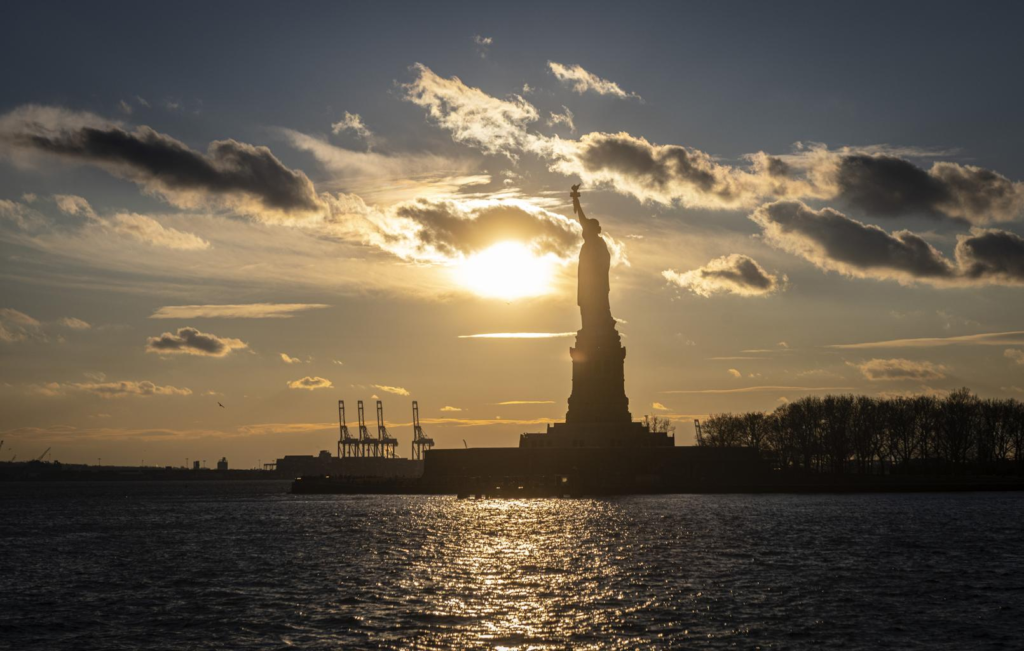
Few landmarks represent the United States more clearly than the Statue of Liberty in New York Harbor. Dedicated in 1886 as a gift from France, the statue quickly became associated with immigration and the promise of opportunity.
For millions of immigrants arriving through Ellis Island during the late 19th and early 20th centuries, the statue was their first glimpse of America.
The symbolism deepened with the famous lines from Emma Lazarus’s poem “The New Colossus,” which describe America as a refuge for those seeking freedom and opportunity.
Today the statue represents multiple layers of American identity:
- Freedom and democracy
- Immigration and cultural diversity
- International friendship
- The enduring ideal of opportunity
The monument welcomes more than 4 million visitors annually, according to National Park Service data, reinforcing its status as one of the most recognized symbols in the world.
Mount Rushmore: Presidents Carved Into the Landscape
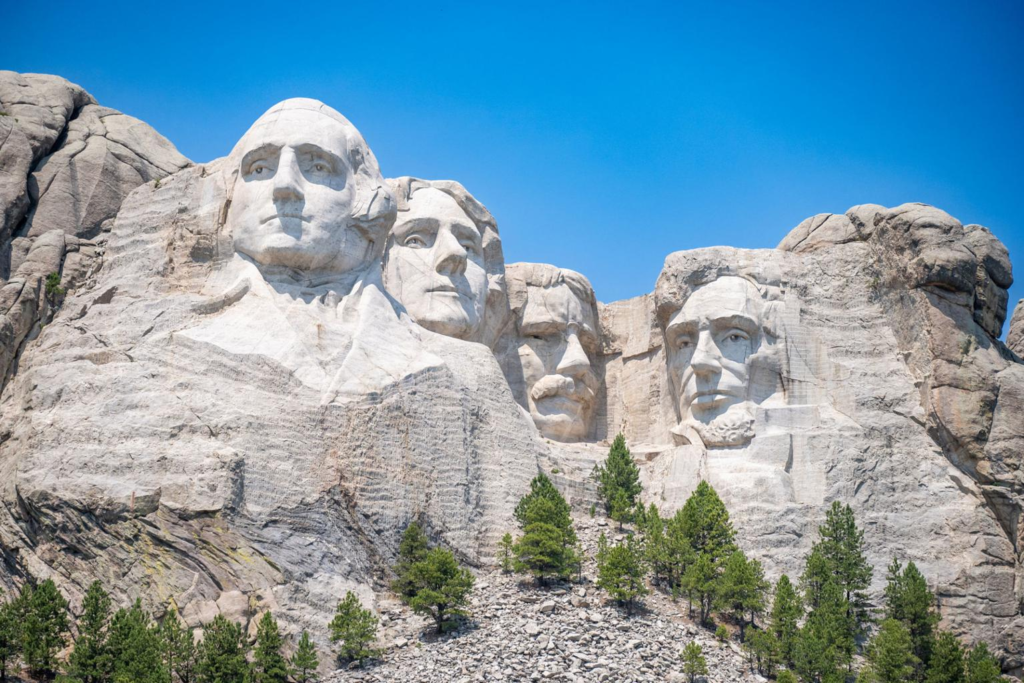
Mount Rushmore in South Dakota transforms political leadership into monumental art. Sculpted between 1927 and 1941 by Gutzon Borglum, the massive granite faces of George Washington, Thomas Jefferson, Theodore Roosevelt, and Abraham Lincoln represent four defining eras of American development.
Each president symbolizes a different national milestone:
- George Washington: founding of the nation
- Thomas Jefferson: expansion and democratic ideals
- Theodore Roosevelt: industrial growth and conservation
- Abraham Lincoln: preservation of the Union
While the monument has also sparked discussions about Indigenous history and land rights, it remains one of the country’s most recognizable landmarks.
Approximately 2.5 million people visit each year, reflecting its ongoing cultural relevance.
The Lincoln Memorial: A Civic Stage for Democracy
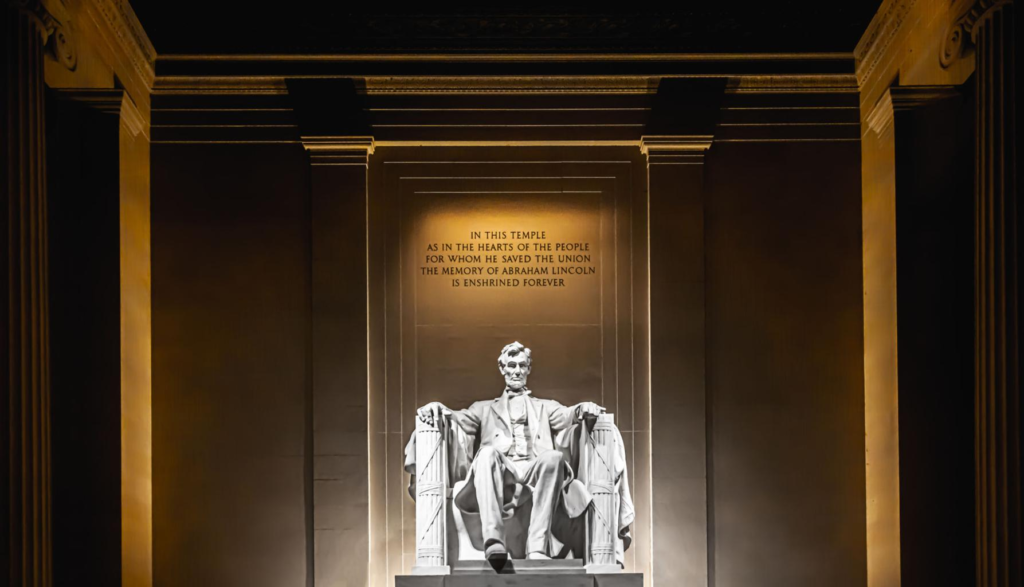
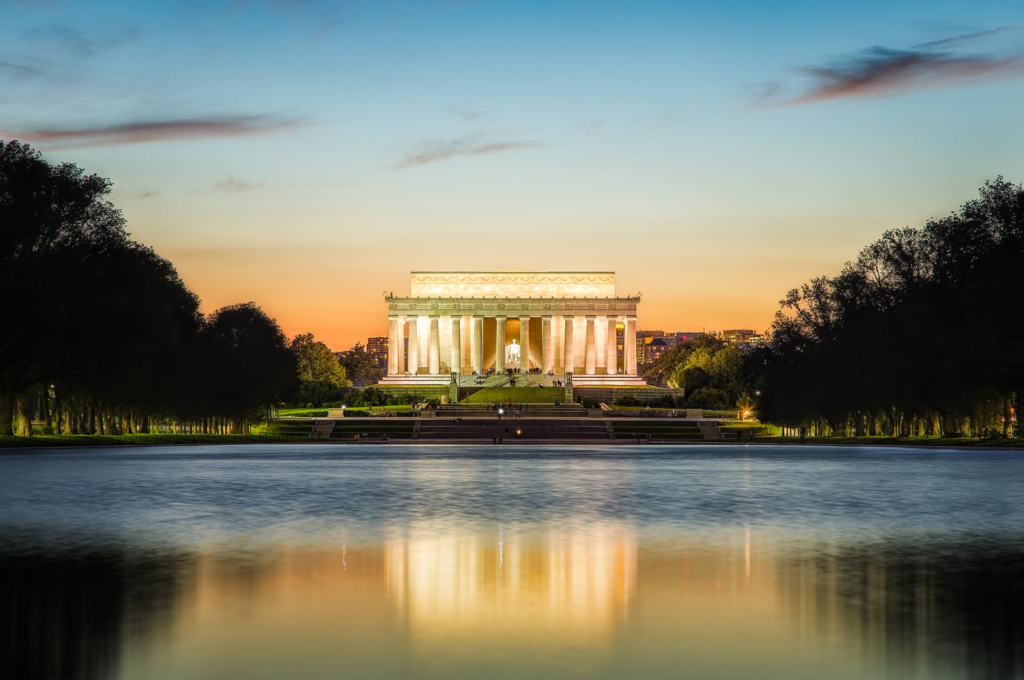
Located on the National Mall in Washington, D.C., the Lincoln Memorial serves both as a tribute to Abraham Lincoln and as a gathering space for civic expression.
Completed in 1922, the memorial’s design resembles a Greek temple, symbolizing the enduring nature of democratic ideals. The seated statue of Lincoln faces the National Mall, creating a powerful visual axis with the Washington Monument and the U.S. Capitol.
Beyond architecture, the site has played a pivotal role in American history.
Major events held there include:
- Martin Luther King Jr.’s “I Have a Dream” speech (1963)
- Civil rights demonstrations
- National commemorations and memorial ceremonies
Because of these moments, the Lincoln Memorial has become more than a monument—it is a stage where Americans publicly define the meaning of equality and democracy.
The Golden Gate Bridge: Engineering Meets Cultural Identity
Opened in 1937, the Golden Gate Bridge connected San Francisco to Marin County and became one of the most recognizable engineering achievements of the 20th century.
At the time of completion, it was the longest suspension bridge in the world. Its distinctive International Orange color and sweeping Art Deco design quickly made it visually iconic.
Today the bridge represents several themes tied to American culture:
- Engineering ambition during the Great Depression
- The identity of California and the American West
- The intersection of nature and infrastructure
- American design and innovation
The bridge supports over 100,000 vehicle crossings daily, yet it remains one of the most photographed landmarks on Earth.
Gateway Arch: Symbol of Westward Expansion
The Gateway Arch in St. Louis stands as the tallest monument in the United States at 630 feet. Completed in 1965, the stainless-steel structure commemorates the westward expansion of the United States and the city’s role as the historic “Gateway to the West.”
Designed by architect Eero Saarinen, the Arch represents a modern interpretation of national symbolism.
Its meaning reflects several themes:
- Exploration and expansion
- Mid-century American design
- Technological progress
- National ambition
Visitors can ride a tram to the top of the Arch, where views stretch across the Mississippi River and the American Midwest.
The Grand Canyon: A Natural Landmark That Defines the Nation
While many national symbols are human-made, the Grand Canyon demonstrates how natural landscapes can shape national identity.
Located in Arizona, the canyon stretches 277 miles and reaches depths of over one mile, revealing nearly two billion years of geological history.
The canyon became a powerful symbol for several reasons:
- It represents the scale and diversity of the American landscape
- It helped inspire the national parks movement
- It reflects the country’s commitment to conservation
President Theodore Roosevelt famously urged Americans to preserve the canyon, calling it a place that should remain “as it is.”
Today the Grand Canyon attracts about six million visitors each year, making it one of the most visited national parks in the United States.
How Landmarks Shape National Memory
Landmarks influence how societies remember their past. Physical places provide tangible connections to events, people, and ideas that might otherwise fade into abstraction.
In the United States, monuments and landscapes often function as shared reference points for national storytelling.
For example:
- School textbooks frequently use images of these sites when teaching history.
- National holidays often feature ceremonies at symbolic locations.
- Films, documentaries, and news coverage repeatedly reinforce their cultural meaning.
These repeated associations gradually transform landmarks into cultural anchors.
When Americans see the Statue of Liberty, Mount Rushmore, or the Lincoln Memorial, they are not just seeing architecture or geography—they are seeing representations of freedom, leadership, democracy, and national resilience.
Visiting America’s Iconic Landmarks Today
For travelers, these sites provide more than photo opportunities. Visiting them can deepen understanding of American history and cultural values.
Many landmarks are managed by the National Park Service or local preservation authorities, which means visitors can access educational exhibits, guided tours, and historical interpretation programs.
Travelers planning visits often benefit from:
- Arriving early during peak seasons
- Using official park websites for reservation systems
- Exploring visitor centers for historical context
- Attending ranger talks or guided tours
Experiencing these places firsthand often reveals details—scale, setting, craftsmanship—that photographs cannot fully capture.
Frequently Asked Questions
What is the most recognized landmark in the United States?
The Statue of Liberty is widely considered the most globally recognized American landmark due to its association with freedom and immigration.
Why do landmarks become national symbols?
Landmarks gain symbolic meaning when they represent historical events, cultural values, or achievements that resonate widely with the public.
Which U.S. landmark attracts the most visitors?
The Lincoln Memorial and National Mall area receive tens of millions of visitors annually, making it one of the most visited landmark regions in the country.
Are natural landmarks considered national symbols?
Yes. Natural sites like the Grand Canyon and Yellowstone represent the country’s environmental heritage and commitment to conservation.
Who decides which landmarks are preserved?
Many iconic landmarks are managed by the National Park Service, state governments, or preservation organizations.
Why was Mount Rushmore built?
The monument was created to promote tourism in South Dakota while honoring four presidents who shaped American history.
What makes the Golden Gate Bridge historically important?
It represented a major engineering achievement during the Great Depression and connected previously isolated regions of Northern California.
Can visitors go inside the Gateway Arch?
Yes. A tram system carries visitors to an observation deck at the top.
Why is the Lincoln Memorial important to civil rights history?
It was the location of the 1963 March on Washington where Martin Luther King Jr. delivered his famous speech.
How do landmarks influence national identity?
They provide physical reminders of shared values, historical milestones, and collective aspirations.
America’s Icons in the Landscape of Memory
Across a continent-sized nation, landmarks serve as anchors of identity. They help Americans visualize their history and communicate national ideals to the world.
Whether carved into mountains, built across bays, or formed by nature over millions of years, these places connect generations through shared meaning.
They remind visitors that the story of the United States is written not only in documents and speeches—but also in stone, steel, and landscape.
Key Insights at a Glance
- National landmarks become symbols through history, visibility, and cultural meaning
- The Statue of Liberty represents freedom and immigration
- Mount Rushmore reflects leadership and nation-building
- The Lincoln Memorial embodies democratic ideals and civil rights history
- The Golden Gate Bridge symbolizes engineering innovation
- The Gateway Arch represents westward expansion
- The Grand Canyon highlights America’s natural heritage